I've Had Two First Acts. Here's What That Taught Me About the Second.

I didn't arrive at entrepreneurship cleanly.
There was a corporate career first. Then ventures of my own — some that worked, some that didn't, all of them teaching me something I couldn't have learned any other way. By the time I was building V1 Scale, I had already done enough to know what hitting a ceiling felt like — not as a theory, but as a lived, physical thing. The moment where working harder stops producing different results.
I've hit that ceiling inside organisations that weren't mine. I've hit it inside ones that were.
Both versions feel the same from the inside.
What the First Act Actually Gives You
There's a version of the "start later" conversation that sounds like consolation. It's not too late. Age is just a number. Experience is valuable too.
I'm not interested in that conversation. It's condescending — and it misses the actual point.
The first act — whether that's a corporate career, a previous venture, or both — doesn't just give you experience. It gives you things that can't be manufactured on a faster timeline:
A network that trusts you because you've earned it, not because you asked for it. Pattern recognition that lets you read a situation in minutes that would take a younger operator months to diagnose. The scar tissue from previous failures that turns fear into data rather than paralysis. A financial position that means you can build smart instead of building desperate. And a clarity of purpose — a "why" — that only arrives after you've spent long enough building for someone else's vision to know exactly what yours looks like.
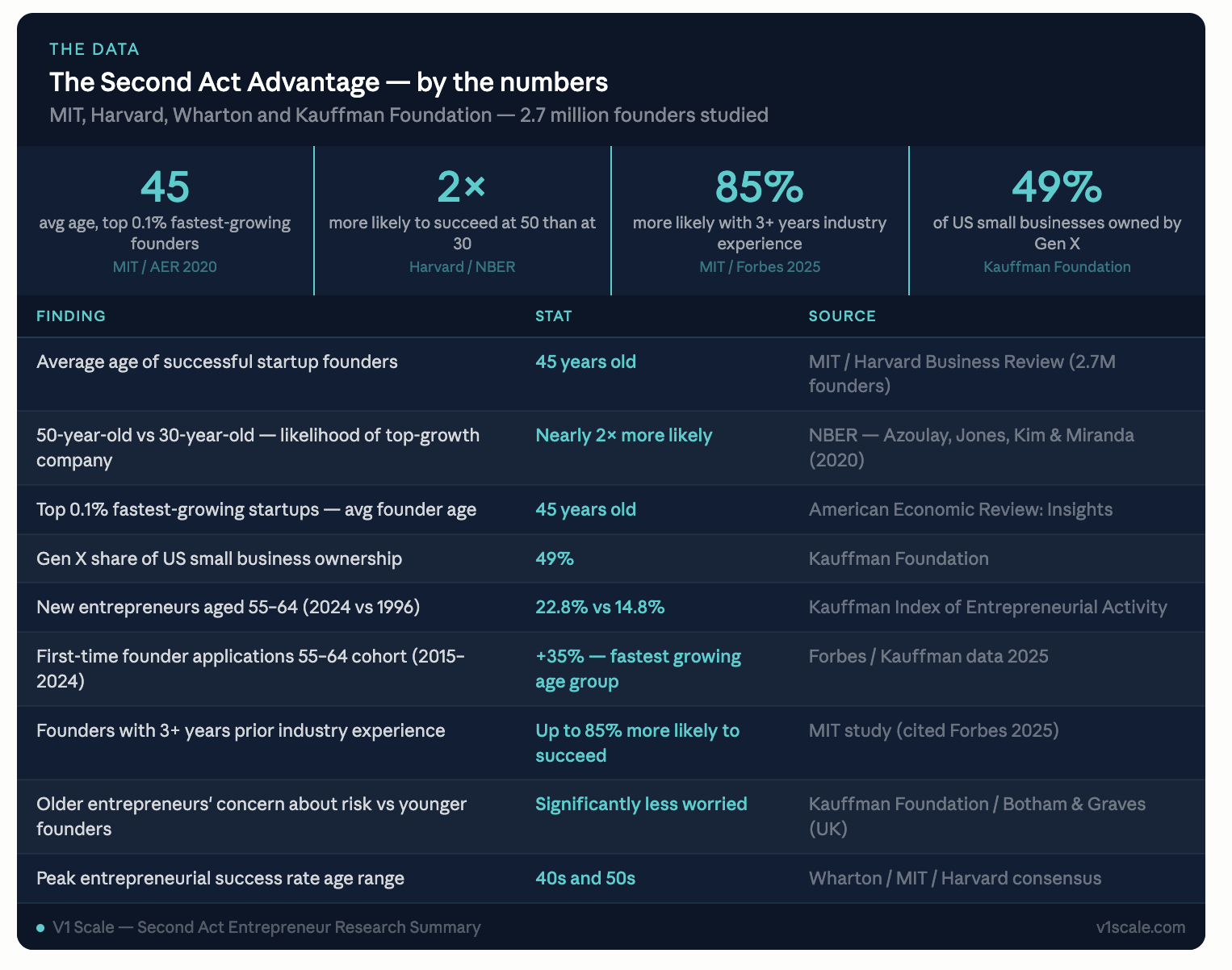
MIT economists confirmed this with data across millions of founders. A 50-year-old entrepreneur is nearly twice as likely to build a top-growth company as a 30-year-old. The average age of founders in the top 0.1% of growth in their first five years is 45. The Kauffman Foundation found that Americans aged 55–64 start new businesses at a higher rate than those in their twenties — and have done, every year since 1996.
The data already knew what the culture refused to say.
What I Got Wrong in the First Acts
Here's the part that the "experience is valuable" conversation usually skips.
I also carried things from the first acts that weren't assets. Patterns of operating that worked in one context and quietly calcified into assumptions I didn't know I was making. A belief that scaling meant hiring — that more output required more human capacity, and that the ceiling I kept hitting was fundamentally a headcount problem.
It wasn't. It never was. It was an architecture problem.
The E4 model — conventional operating structures built on human effort and manual execution — has a hard ceiling built into it. You can feel it before you can name it. More effort produces diminishing returns. The business becomes dependent on key people in ways that make it fragile. The entrepreneur ends up closer to the operational centre than the strategic one. Hiring another person doesn't fix it because the structure itself is the constraint.
I spent longer than I'd like to admit working harder inside a broken architecture before I understood what needed to change.
Why I Built V1 Scale for This Cohort
When I started building V1 Scale, I wasn't targeting the Second Act Entrepreneur as a market segment. I was building the thing I needed — and I happened to be one.
The operators I work with are the same. They're not inexperienced. They're not lacking in capability or network or ideas. They're experienced operators who've hit the structural ceiling of what the first act's operating model can deliver — and they need a different architecture, not more of the same effort.
The SynAgentic Age changes the equation for this cohort specifically. The network you've spent 20 years building, the domain knowledge that used to live only in your head, the pattern recognition that lets you see around corners — all of it can now be operationalised at scale through Agentic Citizens who handle execution permanently, without burnout, without the fragility of key-person dependency.
A 25-year-old doesn't yet have the assets for this to compound on. You do.
The Second Act Isn't a Fresh Start
That's the framing I'd push back on hardest.
The Second Act isn't about starting over. It's about taking everything the first act built — the network, the resilience, the pattern recognition, the clarity of purpose — and giving it an architecture worthy of it.
"Your past isn't behind you. It's the foundation everything gets built on from here. If not now, when?"
That's what I'm building at V1 Scale. And it's why the Second Act Entrepreneur isn't a niche we serve. It's the cohort we were built for.
If any of this resonates, I'd start at V1 Scale — specifically the Venture Builder page. That's where the architecture lives.
[v1scale.com/v1-venture-builders]
What the first act actually built — whether you knew it or not:
A network that trusts you because you earned it
Pattern recognition that reads a room faster than any tool can
Scar tissue that turns fear into data
Financial stability that means you can build smart, not desperate
A "why" forged from years of building for someone else's vision
The E4 ceiling — which means you're already at the starting line
I spent years trying to solve an architecture problem with effort. The Second Act is what happens when you finally stop — and build differently.